
Practical & Straightforward Information on Finding the BEST Pruning Shears
When trying to achieve the desired shaping in shrubs or trimming overgrowth, it’s important to have the right tools that will perform.
Are you guilty of grabbing hedge trimmers or a pair of scissors to get the job done?
There is nothing more detrimental to the health of our landscape garden than to go cutting on plants all willy nilly. Hedge trimmers have their specific purpose as well as scissors, and neither should be used in pruning.
Pruning is judicious cuts of your greenery that should be done by hand with pruning shears.
Every cut should be clean without twisting or shredding of the cut-site. Anything outside of a clean-cut will cause stress to the plant exposing it to disease.
In a Hurry?
Here’s Our TOP FIVE Recommended Pruning Shears
What are the BEST pruning shears?
Number | Preview | Title | Price |
|---|---|---|---|
#1 |  | Felco F-2 Classic Manual Hand Pruner | |
#2 |  | Gardenite Power Drive Ratchet Pruning Shears | |
#3 |  | Lakaw Bypass Pruning Shears | |
#4 |  | Fiskars 35J Bypass Pruning Shears | |
#5 |  | Gonicc GPSS-1003 | Check On Amazon |
We will take a look at various brands along with their features, reviews, and the pros/cons of each.
You will be armed and ready to purchase the best pruning shears for use in your garden!
1. Felco F-2 Classic Manual Hand Pruner
- Diameter cut up to 1”
- Lifetime warranty
- Anvil Blades made of high-quality hardened steel
- Ergonomic comfort handles with shock-absorbing non-slip cushioning
- Hand Size: Large
- Uses: light pruning, GREEN branching, up to 1” thickness
Felco F-2 Classic Manual Hand Pruner
Pros
- Lifetime warranty
- Cut diameter on these shears allow you to cut thicker branches.
- Ideal for larger hands.
Cons
- The tip of the blade is exposed posing potential injury to bare hands.
- Pricey in cost.
- Difficult to use for those with smaller hands.
The Bottom Line:
You must be willing to pay the pricey cost for a good quality pair of shears such as these.
The Felco F-2 shears are great for bigger hands.
If you are looking for shears that can handle thicker branches up to an inch thick, these are it!


No products found.
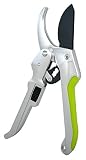
2. Gardenite GT-3142 Power Drive Ratchet Pruning Shears
- Powerful ratchet mechanism delivers 5X the cutting power without the effort
- Cuts thicker branches in steps with ratchet locking
- Anvil blades made of high quality hardened steel with Teflon-coating to repel sap
- Ideal for those with arthritis and carpal tunnel
- Hand Size: Small to Medium
- Uses: moderate to heavy pruning, GREEN branching, thicker branching
Gardenite GT-3142 Power Drive Ratchet Pruning Shears
Pros
- Ratcheting helps to cut thicker branching with ease.
- Teflon blades make cleanup a breeze.
- Great for women to use as well as those with hand conditions.
Cons
- Locking mechanism faulty at times.
- Overall durability lacking.
- Difficult to use for those with large hands.
The Bottom Line:
These shears are designed for smaller hands and those with arthritis or carpal tunnel.
Although the ratings are good, numerous reviews are consistently reporting durability issues.
If you are not a heavy pruner with small hands, these shears should perform to your expectations.

No products found.
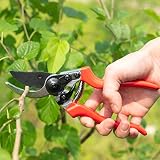
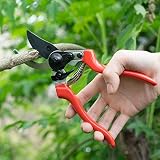
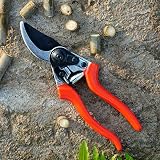
3. Lakaw LK-03041 Bypass Pruning Shears
- Hardened steel blades
- Ergonomic non-slip handles
- Lightweight
- Ideal for those with arthritis and carpal tunnel
- Hand Size: Medium to Large
- Uses: light to moderate pruning, DEAD/BRITTLE branching
Lakaw LK-03041 Bypass Pruning Shears
Pros
- Ratings and reviews are extremely impressive.
- Easy to use with the ability to cut through bold branching.
- Affordably priced.
Cons
- We can’t think of any
The Bottom Line:
These pruning shears have perfect ratings with outstanding reviews.
The overall comfort and ease of use coupled with the durable craftsmanship make these shears a perfect buy!
No products found.
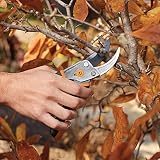
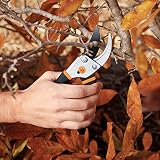
4. Fiskars 91095935J Bypass Pruning Shears
- Diameter cut up to 1”
- Lifetime warranty
- Anvil Blades made of high-quality hardened steel
- Ergonomic comfort handles with shock-absorbing non-slip cushioning
- Hand Size: Large
- Uses: light pruning, GREEN branching, up to 1” thickness
Fiskars 91095935J Bypass Pruning Shears
Pros
- Non-stick carbon steel for ease in smooth cutting.
- Ambidextrous locking mechanism.
- Dual-layer comfort handles.
- Lifetime warranty.
Cons
- Blades tend to suffer after heavy use. Chipping and knicking are reported issues in reviews.
- When cutting in upwards position, the lock switch falls down getting in the way.
The Bottom Line:
If you are looking for an inexpensive pair of pruning shears for lighter jobs, these will do the job.
The blades are not apt to handle biting into thicker branching.
A positive is if you have any problems, the lifetime warranty affords you replacements.

No products found.
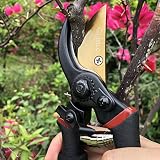
5. Gonicc GPSS-1003 Premium Bypass Pruning Shears
- Titanium steel blades with Ultra-Fine Polishing Teflon technology to prevent the buildup of sap
- Ergonomic non-slip handles
- Hand Size: Medium
- Uses: light to moderate pruning, DEAD/BRITTLE branching, up to 3/4” thickness
- Lifetime warranty
Gonicc GPSS-1003 Premium Bypass Pruning Shears
Pros
- Near-perfect ratings and reviews.
- Easily handles thicker branch cutting.
- The lifetime warranty gives you peace of mind.
- Blades are resistant to sticky sap buildup.
Cons
- Larger hands find these somewhat difficult to use.
- The screw that holds the two pieces together tends to be loose or come out.
The Bottom Line:
Gonicc pruning shears are all backed by a lifetime warranty.
This gives buyers the assurance that replacements are no problem.
If you have large hands, you may not find these comfortable to use.
Overall, these pruning shears perform well.
Both ratings and reviews were positive!
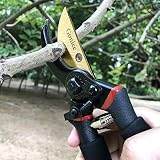
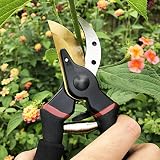
No products found.
What are Pruning Shears?
Pruning Shears are a hand held, hand operated, gardening tool.
They are designed similarly to scissors and perform a similar function to them.
In fact, pruning shears are sometimes referred to as gardening scissors. There is a difference though. Garden shears are not designed to cut paper and regular scissors are not designed for outdoor use.
Garden shears are used to cut or trim shrubbery, small branches, and can also be used to harvest flowers or produce from a garden.
Types of Blades: Anvil vs. Bypass
Depending on your pruning projects, choosing a specific type of blade will determine the behavior of the cutting action.
Anvil
Cutting action: crushing motion which causes branching to separate.
Uses: branching that is dead and brittle.
Design: straight blade against a wide anvil blade
Bypass
Cutting action: smooth cut with a scissor-like motion
Uses: green branching
Design: anvil/curved or straight blade against another blade.
Why should I use Pruning Shears?
You should consider using pruning shears if you have a vegetable garden or flower garden that needs to be harvested.
You may also consider using pruning shears if you have bushes or another shrubbery that needs to be trimmed back and landscaped.
By trimming back your bushes and other plants in your garden, you are helping them with their overall growth, health, and shape.
They are easy to use and can produce neatly cut results without strenuous effort from you.
How do I use Pruning Shears?
This hand-held gardening tool might seem self-explanatory to use, and you would be correct.
If you have ever used scissors to cut paper, then you surely can use pruning shears to trim back a bush in your garden.
However, if pruning shears are used incorrectly, then they can become a hazard to the operator and anyone else nearby.
Step one:
The first step you need to do is to take a look at your garden and other landscape.
The best time of year to do this is during the autumn months or whenever your trees, bushes, and plants are reaching their dormancy stages.
Take a walk around your yard and make a mental note (or physical note if that helps you) of every bush, plant, tree and other greenery that needs to be pruned and trimmed.
Once you have an idea of what plants need your attention, then you can move on to step two!
Step two:
Sharpening your pruning shears prior to use is wise.
This is the best way to ensure that you will be able to cut with ease. A fine tooth file should do the trick!
Remember to hold the fine tooth file at an angle against the pruning shears blade and slide it away from your body.
Also, don’t forget to do this along the edge of the pruning shears blade.
Step three:
It is also wise to use gardening gloves when you use pruning shears.
They will keep your hands safe from cuts, scrapes, and potential infection if you were to cut yourself with the pruning shears accidentally, or if you were to be dealing with thorny plants such as a rose bush.
You may also want to use a pair of safety glasses to help protect your eyes.
Step four:
Now you are ready to begin!
Go to your first plant and find a small section or branch that needs to be trimmed. Hold that section or branch between your gloved fingers, firmly.
Do not twist the branch!
With your pruning shears in your other hand, snip the branch as far down as you want to create the landscaped look you desire.
The pruning shears should make a clean cut through the branch.
If you are unable to cut through that particular section, then you may need to choose a smaller section or larger shears.
Be sure that each cut you make is smooth and clean! Otherwise, you could damage the plant.
Also, be careful not to trim your plant too much!
Step five:
After you have cut the plants that you made a mental note of earlier, and you are satisfied with your landscaping now it is time to clean up!
Using a garbage bag or another collection method, gather all of the trimmed pieces from around your yard.
Once the yard has been landscaped and cleaned up, you can now rinse and dry your pruning shears as well as replace the protective cover.
Put them away in a safe place for next time!
What are the benefits to using Pruning Shears?
Pruning Shears make landscaping your bushes and plants easy.
They are an excellent way to not only make your yard look good, but pruning will also help your shrubs and plants to remain healthy, strong, and lively each year.
Overall plant health is improved
Removes decaying/dead parts that can spread disease
Aids in pest control
Encourages growth
Promotes beauty
Helps to train and shape greenery for the desired look
Your Take-Away On Pruning Shears
Again, using the right tool is the key to doing the job right. The variety of designs and materials in shears give you more to choose from.
Remember the following when considering pruning shears:
Size of your hands
Strength of your hand
Diameter of cut (thickness)
Amount of pruning you plan to do
Deciding on whether you use anvil or bypass pruning shears should be based on if you are pruning green or dead/brittle branching.
Be careful when handling your pruning shears because those sharp blades can definitely bite you back!


